


Introduction
Traditionally, the reporting workflow is quite straightforward: the event (e.g. assembly, trial, meeting) takes place, technology records it and reporters produce the final report with the support of more or less technology. Then the report is read by staff and, ultimately, any interested citizen (Image 1).
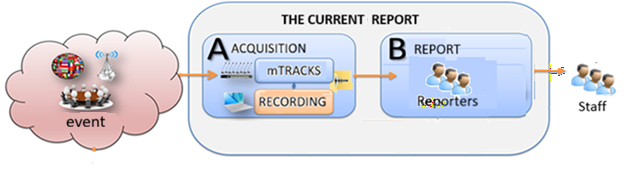
Thanks to advances in AI-driven technology, especially Automatic Speech Recognition (ASR), the role of reporters has remained essential but has changed over time, becoming—quantitatively—more and more marginal as technology has taken over most of the reporting tasks (mainly recording and transcribing). This has allowed for more reports to be produced more rapidly. However, it must be clarified that the required quality and nature of reports have remained unchanged. This means the expectation is that even a fully machine-made report has to meet the standards of a fully human-made one.
Universal Design
Grounded in the principles of Universal Design and with the aim of providing accessible, multipurpose and inclusive reporting services, the notion I would like to discuss here is that of a universal report, addressing the needs of as many potential users as possible.
Let me start from its grounding principle: Universal Design. Universal Design was originally defined by Mace (at the Center for Universal Design in 1997) as the design of products and environments usable by all people without the need for adaptation. Gradually, it has evolved into a more dynamic framework. According to ASPHI (2017), it now encompasses all user-centred services that provide adaptable options capable of satisfying a broader range of users, through systems that learn and adjust automatically. This shift from standardisation to adaptability is central to the universal report, as it prioritises flexibility over uniformity.
The Universal Report
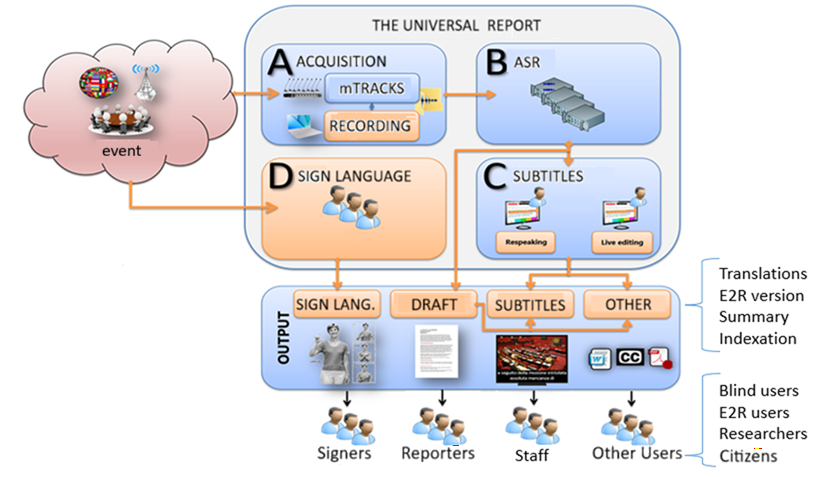
When applied to reporting, the Universal Design approach is designed to meet the needs of the universal report’s primary users. In parliamentary reporting, these include MPs, journalists, citizens; and in courts, judges, parties, juries and defendants. At the same time, it accommodates other individuals with specific needs without the need for adaptation, through systems that learn and adjust automatically and professionals capable of making the most of it. As a result, the quality and nature of the traditional report is maintained and expanded to include extra services. This is done by adding extra layers to the traditional workflow, involving more technology and professionals (Image 2).
How the Universal Report Works
Operationally, once the event takes place, two workflows start:
1. its interpretation into sign language (D);
2. its recording (A), automatic processing (B) and live subtitling (C).
Both workflows include professionals (sign language interpreters and live subtitlers), more or less assisted by technology. Their output is recorded and used by their directly intended target users (deaf people) and indirect ones (any person benefiting from access to the event through signed or written language), either in real time or as a recorded event. Workflow 2 is further processed by professionals such as reporters (who turn the subtitles into an official report), translators (who turn the automatically translated report into an official translation), Easy-to-Read validators (who turn the automatically simplified report into an official Easy-to-Read report), editors (who turn the automatically summarised report into a proper summary report) and IT experts (who ensure that the automatically indexed video matches the report and archive it). Finally, the output is accessed by other types of users such as citizens, researchers, foreigners or users with specific characteristics such as blindness, deafness, intellectual disabilities, low literacy or limited command of the language. Technology today also allows any user to customise access to these services by adjusting the text (font, size, colour, brightness and contrast), the video (size, replay speed and brightness) and the services (by selecting one or more of the above options).
The Impact of the Universal Report
By integrating these multiple modes of access, the universal report ensures that information is available to a wider audience without compromising the quality or accuracy of the services, as the pivot of it all is to keep the remaining human professionals, with their knowledge and expertise. This guarantees that access to the service is easier, more flexible and more thorough, as the selected output is automatically associated with all the other output. So, for example, a judge can access the verbatim report and then select a specific chunk and access the audiovisual recording where the utterance was pronounced to better understand the mood or intended meaning of the speaker, which often goes beyond words. Another example could be that of a journalist, who can access the summary report for an article about a specific topic discussed in parliament. They may want to access the full report to get more details, and finally they access the session’s audiovisual recording for a clearer understanding of how things went and to report the non-verbal side of it.
The key change introduced by this model is the integration of advanced technologies, particularly ASR systems, in human-centred workflows, where professionals work as post-editors of a machine output by monitoring the process, correcting the product (full or summary multimedia report, adaptation into Easy-to-Read language, translation) and finally validating it. By doing so, the role of reporters is reduced in quantitative terms, as machines record the speech and produce the report, but not qualitatively, as the goal of the report remains that of ensuring transparency of institutional activities. Reporters are key to this. In other words, only professionals who know what a professional report is can post-edit a machine-made draft report and turn it into a professional one.
The advantages of universal reporting for reporters are multiple. First of all, they update their skills while continuing to use their previous ones to support the new workflow, as they know what a court or parliamentary report should look like. Furthermore, production times are reduced before a report becomes official. Fatigue is reduced, as the physical and mental efforts involved in the process are quantitatively reduced. Last but not least, the reporting office can provide a wider service portfolio with minimum effort. All in all, this translates into higher standards of living, as the adoption of this model will guarantee more free time for reporters and hence a better work-life balance.
Conclusions
Looking ahead, I expect reporting to become increasingly automated and its use personalised, with advances in ASR likely to lead to more adaptive and user-specific solutions (e.g. reports in multiple languages, in Easy-to-Read language for people with reading difficulties, or with customisable character colours, fonts and sizes). At the same time, the role of human professionals will continue to evolve, as they will focus more on supervision, quality control and complex interpretative tasks such as deciphering a mumbled word, deciding on a critical punctuation mark or deciding which of two homophones is to be used in a given context (Eugeni 2023).
If the universal report is adopted entirely—some of its components have already been adopted in Italy, Finland, Canada, the Netherlands, Japan, the European Parliament and the International Court of Justice, among other institutions (see Tiro issue 11)—it will integrate technological innovation with human expertise and a strong commitment to accessibility for all sorts of users.
Carlo Eugeni is Tiro’s scientific adviser.
References
ASPHI (2013). ASPHI e la Progettazione Universale. URL: https://asphi.it/2013/09/16/progettazione-universale-o-universal-design-o-design-for-all/
Center for Universal Design (1997). The principles of universal design (Version 2.0). Raleigh, NC: North Carolina State University.
Tiro – The Journal of Professional Reporting and Transcription, 1/2025. Issue 11. URL: https://tiro.intersteno.org/2025/06/tiro-1-2025/
Eugeni, C. (2023). “Of Homophones, Referents, and Prejudices”. – Tiro 2/2023. URL: https://tiro.intersteno.org/2023/12/of-homophones-referents-and-prejudices/


[…] Carlo Eugeni:The Universal Report: Integrating Accessibility, Technology and Human Expertise […]